
Reuse, Coating and Handling on Wooden Formwork Beams
Reuse is where a formwork beam earns its keep, and reuse is mostly a handling discipline. Dongstar describes its beam as a section that can typically be reused dozens of times, with a waterproof coating over a North Europe solid wood spruce flange and a laminated plywood web. Cycles are lost to water, to careless stripping and to storage, far more often than they are lost to load.

Key takeaways
- The waterproof coating is what makes a beam reusable, so damage to it is the first thing to look for between cycles.
- Published reuse wording is dozens of times per section, with no fixed cycle count promised by the maker.
- Color-coated ends identify the production batch, letting a yard pull a suspect run out of service quickly.
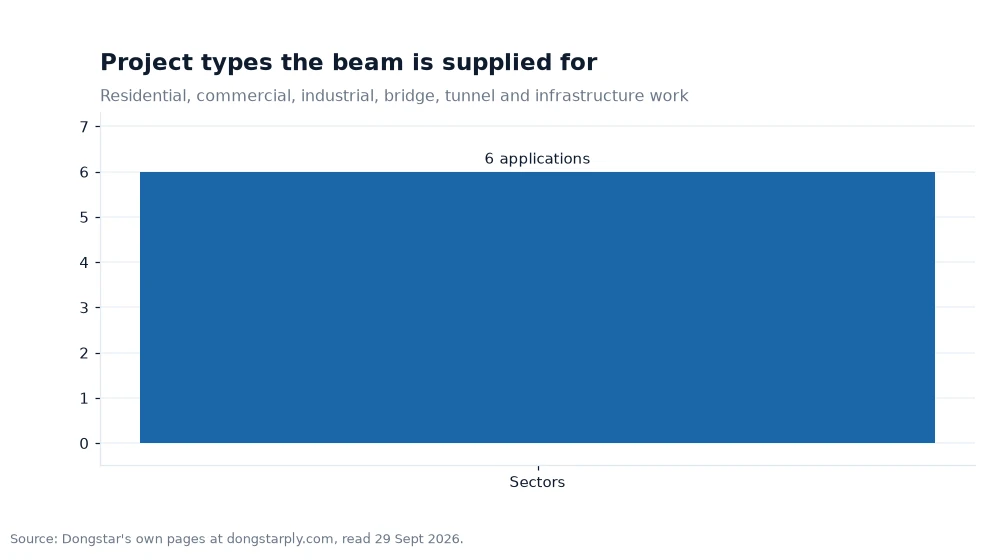
- Supply covers residential, commercial, industrial, bridge, tunnel and infrastructure work, so the same section meets very different pour rates.
The coating is the asset
A formwork section meets water, alkaline concrete and abrasion in the same shift. The published waterproof coating is there to shed the first, resist the second and release the third, and every one of those jobs protects the timber underneath. A coated beam strips more cleanly, needs less scraping, and goes back into the rack in a state that can be used again, which is exactly what a reusable section is supposed to do.
Damage to the coating is therefore not cosmetic. A gouge at a corner exposes end grain, end grain drinks water quickly, and the swollen end then sits out of line with the rest of the beam. The next pour reveals it. Coatings cost least to maintain when the damage is found early, which is why an inspection between cycles beats an inspection at the start of a project.
What dozens of uses actually depends on
Dongstar's own wording on the H20 Timber beam page sets the reuse expectation at dozens of times per section, deliberately without a fixed cycle count. The variables are the ones a site controls: whether beams are struck with a hammer or released properly, whether they are dragged or carried, and whether they sit on bearers or in a puddle.
Two sites running the same beams can therefore get very different service lives. The one that trains its carpenters to release a clamp before levering a beam, and that stacks off the ground at the end of a shift, keeps its sections in the rotation for far longer than the one that treats them as consumable timber. Neither site changes the product; they change the cycle count.
Striking, carrying and setting without wrecking the section
The useful habits are unglamorous. Strike from the middle of a span rather than the end, so the beam comes away from the slab without a levering point at its weakest location. Lower beams rather than dropping them, because a fall lands on an end or a flange edge, and both are where the coating is thinnest. Carry long sections between two people instead of dragging them across the deck.
Setting is the same discipline in reverse. Beams placed onto clean, level supports sit in the system the way they were designed to, and length errors show up as gaps rather than as force applied through a clamp. Handled this way, the published claim of low deflection and quick assembly is not marketing: it is what the section does when nothing has been done to it.
Storage between pours
Moisture is the quiet enemy of every timber component, beams included. Sections stored flat on the ground take up water through the lower faces and dry unevenly on top; the section that results is rarely out of tolerance by much, but it is out of tolerance in the same direction every time. Bearers, a dry floor and a cover are enough to avoid the problem, and they cost less than one replacement beam.
Storage also decides how quickly a batch can be issued. Beams are made in runs and identified by batch; if the racks are organised so that older runs are used first, the whole stock turns over and no single batch ages in the corner. That is basic stock control, and on formwork it prevents the surprise of an eight-month-old beam failing an inspection.
Color-coated ends as a management tool
Color-coated ends turn an anonymous pile of timber into a traceable stock item. The colour on the end records production batch, which lets a storekeeper answer two questions quickly: how old is this beam, and is this the same run as the one that has just been reported damaged? On a large site with several deliveries, those questions come up weekly and are expensive to answer by measurement alone.
There is a safety argument as well. If an inspection finds a cracked flange on one beam, the batch mark tells the supervisor whether to keep looking through the rest of that run or to put the section down to isolated impact damage. Isolating a batch is a decision that depends entirely on being able to identify it.
| Factor | Published position | Where cycles are lost |
|---|---|---|
| Surface | Waterproof coating over the section | Scraping, dragging and standing water attack the coating first |
| Flange | North Europe solid wood spruce, 80 mm by 40 mm | Levering at the end splits timber at the fixing line |
| Web | Multi-layer laminated plywood | Impact damage and ground contact, not normal bending |
| Ends | Colour-coated for batch tracking | Untraceable runs stay in service longer than they should |
| Service life | Typically dozens of uses in the maker's wording | Handling discipline, not the load, sets the total |
One section across six kinds of project
The published applications run from residential and commercial buildings through industrial work to bridges, tunnels and infrastructure. Those jobs put very different demands on a beam. House building produces many short cycles; a bridge or tunnel deck may produce fewer, heavier pours with longer spans and more propping, and the beams may be in the system for months rather than days.
Buying one section type across all of them is a simplification, and it works because the beam is a component rather than the structure. The span, prop spacing and loading come from the engineer's design; the beam simply has to sit in it consistently. That is why the published selling points are about geometry and handling rather than about a load table the maker has not published.
Worked example: counting cycles over a project
Suppose a site strips and re-sets each beam four times a month on an illustrative programme (example). Over a twelve-month project that is 4 × 12 = 48 handling cycles per beam (example arithmetic). If a careless strike costs the coating at an end every twentieth cycle, the same beam would need attention roughly twice in the year: 48 ÷ 20 = 2.4, so three interventions rounded up (example).
Now run the same programme with beams stored on bearers and struck from mid-span. Halving the damage rate to one incident every forty cycles gives 48 ÷ 40 = 1.2, or two interventions (example). The arithmetic is not a promise about any specific beam; it shows why handling practice, not the pour calendar, is what decides how much of a rack survives the year.
Frequently asked questions
How many reuses should a buyer plan for?
The maker expects dozens of reuse cycles from a section rather than promising a set figure. What the achieved count comes down to is stripping practice, storage, and how well the waterproof coating is maintained.
What is the biggest threat to a coated beam?
Water reaching bare timber at a damaged edge or a chipped corner, and abrasion from dragging sections across the deck. Both are visible between cycles, and both are cheaper to repair than to ignore.
Does one beam type suit every kind of project?
Supply covers residential, commercial, industrial, bridge, tunnel and infrastructure work with the same section, but the span, prop spacing and loading come from the project's own formwork design rather than from the beam alone.
Where to check the rest of the forming setup
Beams and forming sheets age together, so it is worth reading the two specifications side by side. The catalogue sets out the film faced sheet used against concrete, while the complete product list shows what else can travel in the same shipment. Matching the sheet and the section before a first order is how a formwork package stays consistent.
Reuse wording, coating notes, batch marking and application lists above derive from the company's own site, checked on 29 Sept 2026, and carried into the table above, and used in the notes below[1].